
Bursa Tour
Bursa Tour opens with a city shaped by early Ottoman heritage, layered commerce, and rising natural landscapes. Historic mosques, silk bazaars, and thermal quarters align within a rich urban fabric, where each district carries its own character. Stone courtyards, domes, and narrow streets guide the rhythm of exploration, shifting between lively centers and calm hillside views. Uludağ stands as a constant backdrop, adding depth and presence while the city reveals a refined balance between cultural legacy and spatial harmony.
Many travel plans begin or end in Istanbul, where a well-organized Istanbul airport transfer helps connect the journey smoothly with a Bursa tour experience.
Ottoman Religious Architecture
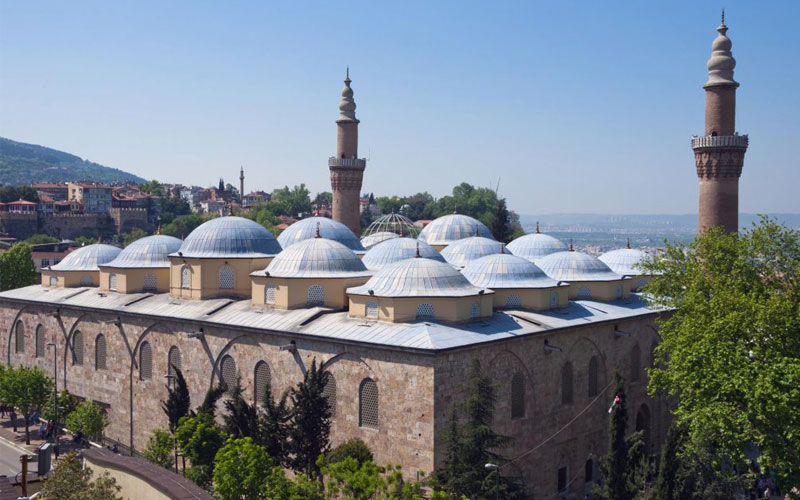
Ulu Camii stands at the center of Bursa with a multi-dome structure arranged in a precise grid. Interior space expands horizontally, supported by thick stone pillars that guide movement across the hall.
A central fountain introduces a continuous sound layer, blending water with filtered daylight from above. Calligraphic panels cover large surfaces, adding visual weight without breaking spatial balance.
Surrounding streets carry a dense pedestrian flow, creating a clear contrast between exterior intensity and interior stillness.
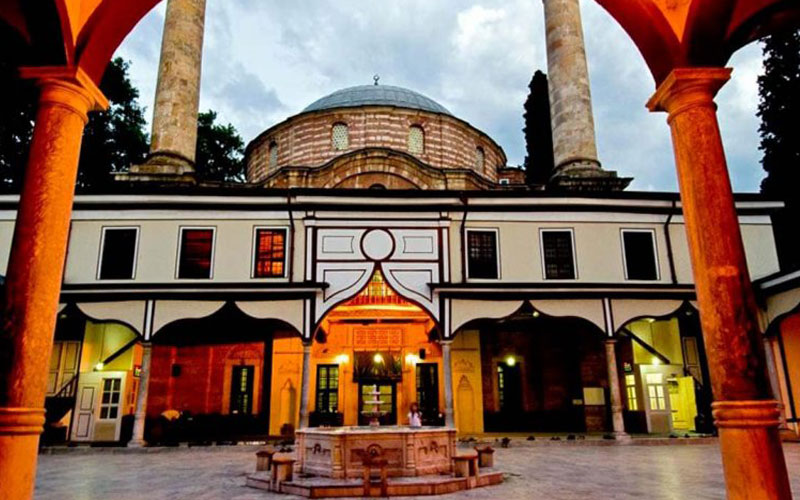
Ulu Camii
Ulu Camii anchors Bursa with a multi-dome composition arranged in a disciplined grid, creating a strong architectural presence at the city core. Thick stone walls and aligned arches define a grounded perimeter, while interior space expands with clarity beneath a sequence of domes that distribute light evenly across the hall.
A central fountain introduces a constant acoustic layer, where flowing water interacts with filtered daylight from above, adding depth to the atmosphere. Large calligraphic panels extend across surfaces with visual precision, reinforcing scale and balance.
Surrounding streets carry an active pedestrian rhythm, intensifying the contrast between exterior movement and the composed stillness inside.
Green Mosque
Green Mosque reflects early 15th-century design shaped through detailed tile work and compact spatial planning.
Entrance portal rises with carved stone patterns, leading into an interior where color dominates perception. Iznik tiles cover walls in layered geometric compositions, creating depth through repetition and contrast.
Light enters in controlled portions, emphasizing surface detail rather than volume. Position along the eastern side of the city connects the structure with quieter streets, where elevation increases gradually and movement slows.

Silk Road Trade Heritage
Silk trade shaped Bursa as a commercial center where architecture followed movement and exchange.
Covered bazaars, inner courtyards, and caravan routes formed a connected system that directed both goods and people. Stone structures provided durability, while open courtyards introduced light and circulation into dense market areas.
Activity builds through the day, with shifting density across narrow passages and wider gathering points. This layer of the city carries a continuous sense of motion shaped by trade rhythm.
Routes that extend toward the Asian side often connect naturally with arrivals or departures, where a well-timed Sabiha Gökçen airport transfer complements the overall Bursa travel plan.
Koza Han
Koza Han centers around a rectangular courtyard framed by two levels of stone arcades.
Ground level carries constant movement between silk shops, while the upper gallery offers a slower visual layer overlooking the space. A small mosque rises on columns at the center, slightly elevated from the courtyard floor.
Light shifts across the stone surfaces throughout the day, creating alternating zones of shadow and clarity. Surrounding bazaar streets extend outward, linking this courtyard to a wider commercial network.
Early Settlement Pattern
Early settlement patterns in Bursa reflect a structure shaped by terrain, climate, and daily routines.
Streets follow natural slopes rather than fixed grids, creating irregular paths that reveal space gradually. Houses align closely, forming narrow passages with limited visibility ahead.
Materials shift toward timber and stone combinations, emphasizing function over scale. Movement feels slower within this layer, where transitions between private and public space remain subtle and continuous.vv